

The Importance of Enterprise Agreement Bargaining
Enterprise agreements set the pay and conditions of employees in a workplace for extended periods and are created through a bargaining process between an employer and their employees. In most cases, enterprise agreements replace the relevant modern award(s) in a workplace.
Employee entitlements are a significant business expenditure which means that a multi-year agreement negotiated during enterprise agreement bargaining is likely to have an extended impact on a business.
How a business undertakes enterprise agreement bargaining and the agreement(s) it makes can also influence future bargaining and agreements. For these reasons, enterprise agreement bargaining can be pivotal in setting a business up for long term success.
How We Can Help
Navigate the complex single-enterprise agreement bargaining framework established by the Fair Work Act 2009 (Cth) (FWA) with the help of our practical resources. We can provide bargaining tips, assist you to understand FWA requirements and timelimits, and keep you up-to-date on the newest developments - all for free.
Latest Blog Article
Communicating with employees during bargaining

As with all aspects of the employment relationship, effective and direct communication between employer and employees is a vital part of enterprise agreement bargaining. This article explores the importance of communication and how it may need to be adapted in different circumstances.
Read the article here.
Subscribe
Find out more about how we handle your information in our privacy policy.
Enterprise Agreement Bargaining Guide
This guide will assist you to navigate each stage of single-enterprise agreement bargaining from start to finish. It provides practical guidance and tips to help you understand bargaining requirements and set you up for success.
Bargaining may be mandatory
Single-enterprise agreement bargaining can be optional, in which case the notification date (which represents the commencement of bargaining and triggers time limits for other obligations) is the date the parties agree to bargain. However, in other instances the Fair Work Act 2009 (Cth) (FWA) may make bargaining with employees mandatory. This doesn't mean you have to make an agreement but you do need to bargain in 'good faith'.
You must bargain if:
-
An employee covered by an agreement that has expired within the last 5 years asks to bargain for a replacement agreement.
-
The Fair Work Commission (FWC) requires you to bargain (e.g. majority support determination, supported bargaining authorisation, single interest employer authorisation).
-
You have already agreed with employees or their representative(s) to bargain for an enterprise agreement.
If bargaining is mandatory, the notification date is the date that the employer was required to bargain. See the date calculator below to understand the relevant time limits.
Opportunities That Bargaining Presents
Modern awards often set employee entitlements across an industry with little flexibility for differences in businesses. Enterprise agreement bargaining is an opportunity to structure your workforce in a way that best suits your business.
Often being operational for 4 or more years, an enterprise agreement can create a period of employee relations stability by locking in employee entitlements, giving you additional clarity and certainty.
Employees must be 'better off overall' under any enterprise agreement compared to the relevant award. Bargaining can allow employers and employees to balance their interests, ensuring employees are sustainably 'better off overall' and helping you become an employer of choice that can retain and attract talent to support your business.
Things to Considering
-
Who will the agreement cover?
If not covering all employees, there should be some geographical, operational or organisational distinction between the employees that will and will not be covered by an agreement. -
Are there sufficient current employees?
A proposed enterprise agreement must be voted for by employees across the range of classifications, employment types and locations contained in the agreement. Bargaining without a sufficient variety of existing employees risks the agreement failing to be approved. -
Do you have specialist support?
Whether internal or external, specialist enterprise agreement bargaining support is vital to ensuring you aren't caught out by the complicated enterprise agreement bargaining framework or employee bargaining representatives. Many advisors can to tailor the level of assistance to suit your business and budget.
Getting Started Checklist
-
Open lines of communication with employees and bargaining representatives to build collaborative relationships. Use a variety of communication methods including email, hard copy documents (e.g. noticeboard) and in-person updates to demonstrate that all reasonable steps have been taken to provide employees with required information.
-
Issue the Notice of Employee Representational Rights (NERR) to all employees covered by the proposed agreement using the specified form within 14 days of agreeing to or being notified of bargaining (Notification Date). Use our date calculator to ensure compliance with the Fair Work Act requirements.
-
Perform industry benchmarking to understand common industry pay rates and entitlements. This gives insight into what employees are likely to be seeking and how to remain competitive. Use our industry agreement search to prepare for bargaining.
-
Create a log of claims outlining the specific entitlements you want any agreement to include (or exclude) and obtain a log of claims from any employee bargaining representatives. The included claims will form the basis of bargaining discussions.
Employee Bargaining Representatives
All employees that will be covered by a proposed agreement are entitled to have a bargaining representative participate in bargaining. Most commonly, unions perform this role on behalf of their members.
However, unions often don't represent a majority of employees in a workplace and you may be concerned about other employees having a voice during bargaining. Unfortunately, its usually not practical for large numbers of employees to be involved in bargaining individually.
To ensure all employees have their views practically represented during bargaining and to prevent some bargaining representatives dominating discussions, you may consider assisting employees to nominate an employee representative(s) from the employee cohort. This can include discussing with employees why nominating a bargaining representative may be beneficial for them, asking employee leaders if they want to be involved, providing forms and a contact person for employees to formally nominate a representative of their choice in writing.
Facilitating the nomination of employee bargaining representatives can help ensure that bargaining truly reflects the views of employees and not outside interests.
Negotiation Process
Explore the process of negotiating a proposed agreement by selecting the steps below.
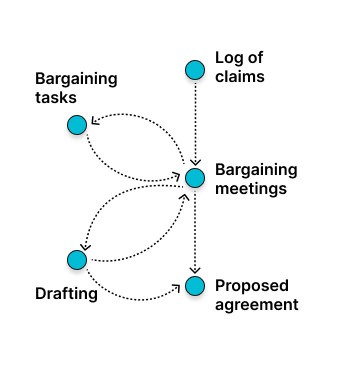
Log of claims
The log of claims of each bargaining party outlines the specific entitlements they want the proposed agreement to include (or not include) and form the basis of negotiations. Logs of claims should be exchanged at the commencement of bargaining. It's important that parties include all claims from the outset as introducing new claims later in bargaining can derail the process.
At commencement, the parties should consider all claims collectively to identify similarities and differences. This allows claims which are relevant to each other to be discussed together, improving bargaining efficiency.
It's important to understand whether any party is proposing that aspects of a relevant award will be incorporated into the proposed agreement. If so, parties should clarify whether some entitlements have been excluded from the log of claims on the basis that the award will apply. It's a good idea to include the incorporation of any award terms in the log of claims.
Bargaining tasks
As parties undertake bargaining meetings, there is often additional work that needs to be completed by one or more parties between meetings to progress the discussions. This can include:
-
obtaining information
-
seeking feedback/approval from management or employees
-
undertaking costing calculations
The progress of future bargaining meetings is often dependent on the completion of these tasks and therefore efficient bargaining requires the parties to complete bargaining related tasks in a timely manner.
Bargaining meetings
Enterprise agreements are important and often complicated documents and it can be difficult to reach agreement on some issues. Bargaining is best advanced through face-to-face meetings (including virtual meetings) to allow issues to be discussed in-depth. The number of meetings will depend on complexity and party claims however it's not uncommon for parties to need in excess of 10 meetings (up to 2 hours each) to conclude bargaining for a proposed enterprise agreement.
How bargaining meetings unfold will depend on the specific parties and their claims. Consider the order in which claims are best discussed as some may be logically or financially dependent on others.
The order in which claims are discussed during bargaining meetings can also be important in helping to foster a collaborative bargaining process. Understanding the likelihood of claims being agreed allows discussions to be undertaken in a way which balances agreement and disagreement, ensuring consistent postive progress throughout bargaining.
Drafting
Drafting a proposed enterprise agreement requires that the principles agreed during bargaining are distilled to clauses for inclusion in the written agreement. However, despite the fact that parties agreed on the general principles of a claim, it's not uncommon for there to be additional negotiation about the specific wording of agreement clauses.
Where a clause is particularly important, complex or subject to lengthy negotiation, there is an increased liklihood that further negotiation will be required regarding the specific clause wording. In these instances, parties may consider undertaking drafting for a specific clause(s) during the bargaining process to allow that additional negotiation to occur without extending the bargaining timeline. This approach is also useful if the resolution of a specific clause is necessary as a pre-condition for the resolution of other claims.
In other instances, the specific wording of a clause for an agreed claim may be straightforward and not require further negotiation. In these instances, parties may choose to defer drafting until the completion of bargaining when the complete proposed agreement can be drafted.
Proposed agreement
The proposed agreement created through bargaining is provided to employees for voting. Generally the proposed agreement will include the matters agreed between bargaining representatives during bargaining and that agreement is indicative of majority employee support.
An employer should only include or exclude entitlements from a proposed agreement without agreement from some or all bargaining representatives if they have made good faith attempts to bargain with representatives and they are confident that a majority of employees will vote in favour of the proposed agreement. This can occur when a bargaining representative for a small number of employees withholds agreement or a large number of employees have not appointed a bargaining representative.
It's important that the proposed agreement is the final version and error free. If the agreement is not finalised before being provided to employees for voting, subsequent changes may invalidate the agreement explanations provided to employees before voting and therefore invalidate the vote itself.
Top Bargaining Tips
-
Consider the order that you discuss claims - some may be dependent on or affect others
-
Communicate and understand the reasoning behind positions to help generate alternatives and reach agreement
-
Track whether entitlements are more or less beneficial than the relevant award (if any)
-
Know the FWC approval requirements to make sure you include required terms and exclude prohibited terms
-
Expect change – a lengthy process can see employer and employee positions change over time.
Good Faith Bargaining Obligations
Once bargaining commences, the Fair Work Act requires that employer and employee bargaining representatives bargain in 'good faith'. Failing to do so can see the Fair Work Commission (FWC) intervene in bargaining.
The 'good faith' bargaining requirements seek to promote agreement making but do not compel parties to make concessions or to reach agreement.
To comply with the 'good faith' bargaining obligations, parties should:
-
recognise and bargain with the other bargaining representatives for the agreement
-
attend, and participate in, meetings at reasonable times
-
disclose relevant information (other than confidential or commercially sensitive information) in a timely manner
-
respond to proposals made by other bargaining representatives for the agreement in a timely manner
-
give genuine consideration to the proposals of other bargaining representatives for the agreement, and give reasons for the bargaining representative’s responses to those proposals
-
refrain from unreasonable or unfair conduct that undermines freedom of association or bargaining
Protected Industrial Action
After bargaining has commenced (provided any previous agreement is within 30 days of or passed its nominal expiry date), employees may be able to take protected industrial action. Its purpose is to support or advance claims in relation to the agreement, provided those claims relate to the employment relationship, union representation and other permitted matters. It cannot be used in support of or to advance unlawful terms.
For industrial action to be protected the FWC must have authorised an employee vote on the industrial action (a protected action ballot) and a majority of relevant employees must have voted in favour.
Protected industrial action can take many forms including displaying bargaining related messages, go slows, work bans and strikes. The type and length of industrial action taken by employees must have been agreed by employees when voting on the protected action ballot.
While employers should not pay employees that are not attending work as a result of protected industrial action, they are not entitled to take other adverse action against employees because of their participation in protected industrial action - doing so amounts to a contravention of the General Protections within the Fair Work Act.
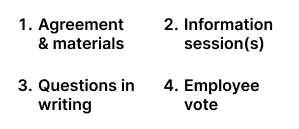
Once bargaining is complete and a proposed agreement has been drafted, the employees that will be covered by the agreement have the opportunity to vote on whether they agree to the proposed agreement.
The Fair Work Act imposes a number of obligations on employers to ensure that employees understand the proposed agreement before voting and have the opportunity to participate in voting. These obligations can have strict timelimits and failing to comply can result in the Fair Work Commission refusing to approve the agreement.
Access period and voting guide
Follow our steps to obtaining agreement from employees to ensure you get it right.


If employees vote in favour of an enterprise agreement, a bargaining representative must make an application to the FWC for approval of the agreement using the specified form within 14 days of the majority agreement. This will usually be done by the employer. The employer should notify employees that the application has been made to the FWC.
Use our date calculator to ensure you comply with the Fair Work Act requirements.
Make sure you're prepared before submitting an application to the FWC to allow the process to be completed more efficiently.
Approval requirements |
Demonstrating compliance |
|---|---|
|
Employees covered by the proposed agreement are 'fairly chosen' |
Identify the objective geographical, operational and/or organisational basis on which employees were included in the coverage of the agreement to show that some employees were not unfairly excluded. |
|
Reasonsable steps taken to provide employees with required information |
Show the specific steps taken to provide employees with the NERR, proposed agreement and related materials, agreement explanation (including the substance of explanations) and vote information. |
|
Agreement contains required terms |
The agreement must contain a coverage term, nominal expiry date (no more than 4 years from the FWC approval date), and dispute resolution, flexibility and consulatation terms. |
|
Agreement does not contain prohibited terms |
The agreement must not contain any unlawful terms such as those which are discriminatory or objectionable, inconsistent Fair Work Act industrial action or right of entry provisions. |
|
Agreement does not reduce or exclude NES |
The agreement must not reduce or exclude any of the 10 minimum employment standards provided by the National Employment Standards (NES). The inclusion of a NES precedence clause in the agreement can resolve inconsistency between agreement clauses and the NES. |
|
Clear relationship with relevant award |
The agreement should clearly state whether or not the award is incorporated into the agreement. If the award is incorporated into the agreement, the agreement should make clear whether the agreement or award clause will apply where the clauses are inconsistent in any way. |
|
Employees are better off overall |
Identify common working arrangements (e.g. shift patterns) and demonstrate that, once all entitlements are considered, employees working in those arrangements are overall better off under the agreement than the award and that any below award entitlements contained within the agreement are more than offset by other entitlements. |
Better off overall test
An enterprise agreement passes the better off overall test (BOOT) if the FWC is satisfied, at the test time, that each current and prospective award covered employee would be better off overall if the agreement applied to the employee than if the relevant modern award applied to the employee. It is not sufficient that a majority of the employees would be better off.
Performing the BOOT requires the identification of those terms of an agreement that are more beneficial and those that are less beneficial to an employee than the relevant award. An agreement may pass the BOOT even if some award entitlements have been reduced, as long as overall those reductions are more than offset by the benefits of the agreement. Each employee must be better off under an agreement, not just receive benefits equivalent to what they would have received under the relevant award. If an award entitlement has no counterpart in an agreement or the corresponding entitlement under an agreement is less beneficial or more restricted in application than in the award, this will affect the assessment of whether the agreement passes the BOOT.
Further information and undertakings
The enterprise agreement making process is complex which can lead to issues at approval time. If a minor procedural or technical issue arises, the FWC will usually try to resolve it with the parties rather than dismissing the approval application. To do so, the FWC may seek additional information to understand what has occured during bargaining and the impact it had. Employers can help advance the approval process by responding to any requests for information in a timely manner.
The FWC may also seek undertakings to rectify issues identified in the approval process, particularly those relating to the reduction or exclusion of the NES or failing the BOOT. An undertaking is an agreement by a party to do a particular thing, often the provision of a particular entitlement in substitute for an agreement entitlement, which becomes a term of the agreement. However, an undertaking cannot result in substantial changes to the agreement.
The existance of more fundamental errors, particularly those which impact the genuine agreement of employees, may mean that the FWC is unable to approve the proposed agreement resulting in the approval application being dismissed. This can require the parties to return to earlier stages of the process including bargaining and getting agreement from employees.
Bargaining Time Limits
Make sure you are comply with the Fair Work Act required time limits by using the date calculator below.
Time limits are often determined with reference to other events, making them tricky to navigate. Getting the dates wrong can delay or derail bargaining and/or approval, so its worth double checking.
Learn more about important dates at the links below:
-
Notification date - when bargaining commences, usually when you agree or are required to start bargaining.
-
NERR date - when employees are provided with the Notice of Employee Represenations Rights (NERR) required by the Fair Work Act.
-
Access period start date - when employees are provided with a copy of a proposed agreement (and related materials) that they will vote on.
-
Vote start and end dates - the period employees can vote on a proposed agreement concluding in the agreement being made or rejected.
-
Approval application date - when an agreement must be submitted to the Fair Work Commission for approval.
Date Calculator
Industry Benchmarking
Benchmarking pay and entitlements involves understanding the pay and entitlements afforded to employees within your industry.
Benchmarking can be helpful to understand what employees may seek during bargaining and ensuring your business's employee costs remain competitive.